The last major currency to be backed by gold at all was the Swiss Franc, which was 40% backed by gold until 2000.
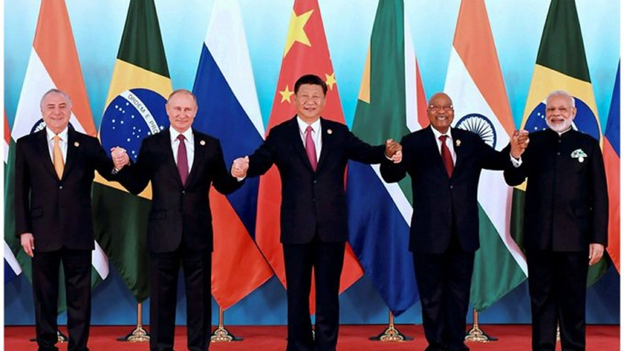
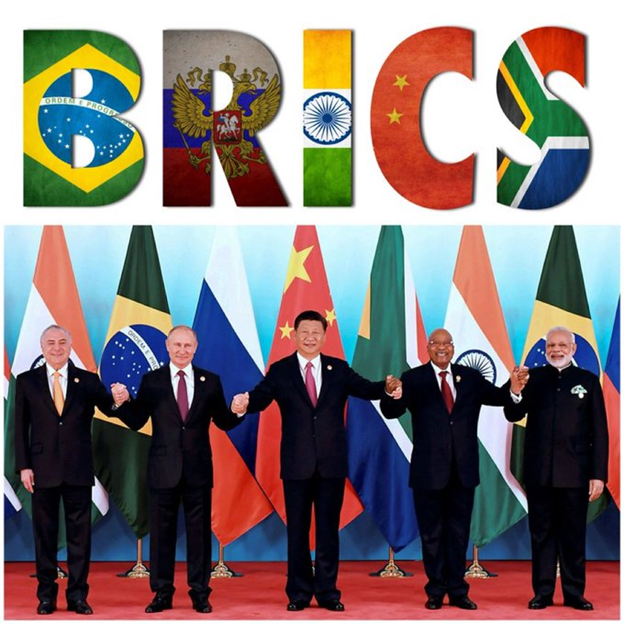
That is, until earlier this week when the BRICS alliance (which includes 10 nations including Brazil, Russia, India, China, South Africa, Egypt, Ethiopia, Indonesia, Iran, and the United Arab Emirates) launched “The Unit” – a new currency backed partially by gold.
The details: this new currency is backed 40% by gold held in vaults by member countries, and the rest is made up of a basket of currencies from some of the member countries.
The basket will hold 12% each of the following currencies:
- Real (Brazil)
- Yuan (China)
- Rupee (India)
- Ruble (Russia)
- Rand (South Africa)
BRICS has been talking about launching its own currency since at least 2022 – coinciding with the seizure of Russian dollar assets from international financial institutions.
As I wrote back in June of this year when the Unit was starting to look like a reality:
“The concept of BRICS started in 2003 (and back then, it was just BRIC – South Africa wouldn’t join the acronym until 2011.) Eventually, the concept turned into a kind of unofficial union that’s been slowly coalescing – leading up to a conference next month to discuss (among other things) the possibility of a new joint currency.
What do these countries have in common? Why did they form this loosely affiliated union?
Culturally, geographically, ethnically, socially – these countries have nothing in common. They could not be more different. If you doubt this assertion, go ahead and misname someone from China as Indian, or someone from Russia as Brazilian. At best you’ll encounter confusion, at worst, a punch in the nose.
The one thing this group has in common is economic. All 5 countries have seen massive ascension over the past 4 decades and together, they now dwarf the U.S. in terms of total GDP.
With the outside exception of China, none of them are close to eclipsing the U.S. in terms of economic power. Also, they’re all major economies outside of the U.S.-Europe economic zone of influence. And especially in a post-Russian sanctions world, all of them bristle at having to conduct business in U.S. dollars. It was tiresome and inconvenient before 2022.
After 2022, it’s a real irritant that all of these major economies would love to get rid of. Why would they have to conduct business in dollars? Why should they?”
This new currency trades using blockchain technology, meaning it’s completely outside of the traditional banking sector, SWIFT or any other levers of power the US can influence.
In fact, in a story on MSN.com, BRICS members explicitly mention the reasons they’re creating the Unit:
“The Unit aims to give them a tool to:
- Settle trade without using U.S. banks
- Store value using gold instead of foreign reserves
- Reduce exposure to dollar liquidity shocks
- Build a cooperative monetary framework independent of Western systems.”
We’ve already seen a massive and historic shift out of dollar reserve internationally:
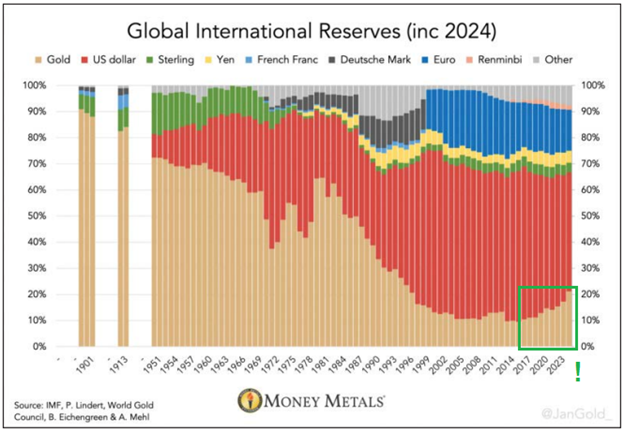
This shift largely benefitted gold.
Everyone sees how the U.S. is running the dollar into the ground. The most obvious safe-haven is gold and now with a new partially gold-backed currency led by some of the most powerful and growing world powers, it looks like the trend will continue.
Add in the context that the Federal Reserve is cutting rates and the Trump administration is pursuing easy-money policy, and dollar denominated gold prices could have a long way to go.
Still… we have not seen gold stocks push through my fair value estimates.
My favorite gold stock right now is still flying well under the radar.
Best,
Garrett Goggin, CFA, CMT
Lead Analyst and Founder, Golden Portfolio